SHOTOKAN KARATE-DŌ
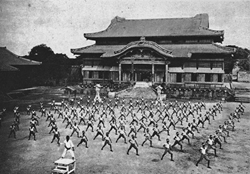
The Shotokan style of karate was developed by Master Gichin Funakoshi, a former schoolteacher who had studied the martial arts of Okinawa with legendary masters Azato and Itosu. In 1922, Funakoshi traveled to mainland Japan to demonstrate at the first national Physical Education Exhibition in Tokyo.
His presentation was a major success and with much encouragement, Funakoshi decided to remain in the Tokyo area to promote, teach, and further develop karate for a new generation of Japanese enthusiasts. Among Funakoshi's earliest students and supporters in Japan were the kendo (Japanese fencing) students of Master Hakuda Nakayama, and it was through this close association that karate's Okinawan origins were transformed into a true form of budō (武道), becoming - alongside kendo, judo, and aikido - an authentic, traditional Japanese martial art.
During the post-war occupation, many American servicemen studied with Funakoshi and his senior students in Japan, ultimately bringing the art back to the United States. In 1958, Japanese karate organizations began sending professional instructors throughout the world to continue working with early enthusiasts who had first trained in Japan and then returned to their home countries. Today, Shotokan is the most extensively researched, written-about, and practiced style of Japanese karate in the world, with over 6,000,000 participants worldwide and active clubs in more than 130 countries throughout all of the Americas, Europe, Africa, Oceania, and Asia.
Fundamentally, Shotokan unites one's mind, body, and technique to create a coordinated and decisive response to an attack. Our training teaches us to observe opponents carefully, detect attacking movements at the earliest possible moment, and respond instantly to protect ourselves. But Shotokan karate is more than just punching and kicking - it provides a complete framework for personal development that transcends fighting skills.
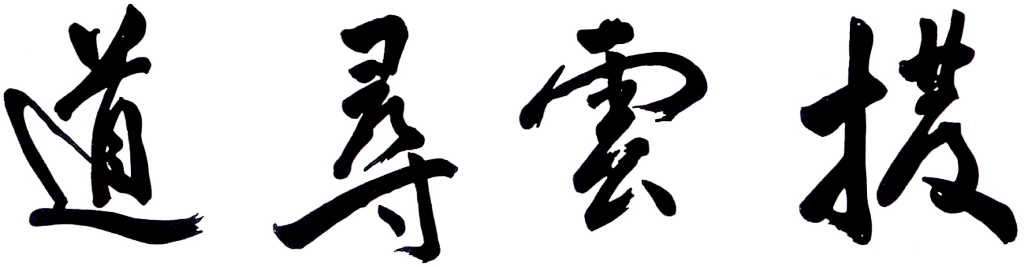
HATSUUN JINDO - Parting the Clouds, Seeking the Way
Calligraphy presented to Gichin Funakoshi upon his arrival to Tokyo c.1922
THE Four "CLOUDS": SURPRISE, FEAR, DOUBT, CONFUSION.
In classical Japanese martial arts (budō) these four conditions of the mind and heart are called shikai - psychological obstacles that limit one's ability to perform at their best in a conflict, regardless of whether such conflict occurs on the street, in a classroom, at work, or in one's personal life.
The physical practice of karate, as an authentic form of Japanese budō, provides a form of moving meditation and active study that allows one to examine, understand, and control shikai - the mental fog that often undermines our progress in the world.
Studying karate provides a series of analogies, strategies, and physical training experiences that help guide students toward mental clarity and mastery of their emotions, and equips them to respond with maximum effectiveness to anything that life throws at them - not just physical attacks.
Learning Shotokan Karate
There are three inter-related areas of training in Shotokan:
Kihon: isolating and studying the fundamental techniques of karate, the building blocks for more complex training. When practicing kihon waza, students are challenged to improve individual elements of karate such as balance, breathing, correct form, focus, speed, and power.
Kata: combinations of kihon waza in structured patterns. In kata, students test their ability to perform kihon waza in sequences that further develop mastery of balance, rhythm, and coordination. Changing tempo, changing direction, examining elements of strategy and tactics, and using different levels of speed, power, and focus are all part of kata practice. At a more advanced level, kata provide a template for many less obvious applications of controlling opponents with grappling, immobilization, and throwing techniques.
Kumite: testing the quality of your techniques in practice with a live partner. In kumite, weaknesses that are not observable in solo practice can be detected, isolated, and corrected. Learning to properly control distance, control timing, control targeting, and control the application of power are all important objectives of kumite practice.
The SKA follows the technical model for Shotokan developed in the 50's, 60's and 70's by the Japan Karate Association (JKA) as described by JKA Chief Instructor Masatoshi Nakayama in his Best Karate book series. Each SKA club's syllabus - how they organize a student's progression through the Shotokan curriculum - is tailored to the needs of the students and the preference of the instructor.
General Comparisons to Other Martial Arts
Shotokan emphasizes powerful “straight line” techniques that are intended to stop an attacker with a single strike. In comparison to most Chinese martial arts like Kung Fu and Tai Chi, Shotokan has fewer large circular movements and uses a somewhat more simplified approach to unarmed combat. Most blocks in Shotokan are intended to be full attacks or counter-attacks on the opponent’s arms and legs.
Shotokan is a striking art that uses the hands, fingers, arms, elbows, knees, and feet as weapons. In comparison to Japanese arts like Aikido, Shotokan has fewer grappling, throwing, and passive response/control techniques.
Shotokan karate does not include ground fighting techniques as commonly found in arts like Judo or Brazillian Jiujitsu.
Although some groups and individuals may participate in tournament competitions as an adjunct to their core training, Shotokan is not sport-focused like Olympic Tae Kwon Do, boxing or MMA. Our practice is suitable for children and adults of all ages and has a much lower rate of injury when properly taught and practiced than common sports like football and basketball.
The study of Japanese/Okinawan weapons is not part of the standard Shotokan curriculum.